15:35 UTC: a valid change becomes a fleet-wide hazard
At 15:35 UTC on October 29, 2025, Azure Front Door generated a configuration that would eventually disrupt its global edge. The input was not an invalid command or a malicious change. A valid sequence of customer route, purge and web application firewall changes crossed two different control-plane build versions and produced incompatible metadata. That metadata exposed a latent defect in the data plane. (Microsoft PIR)
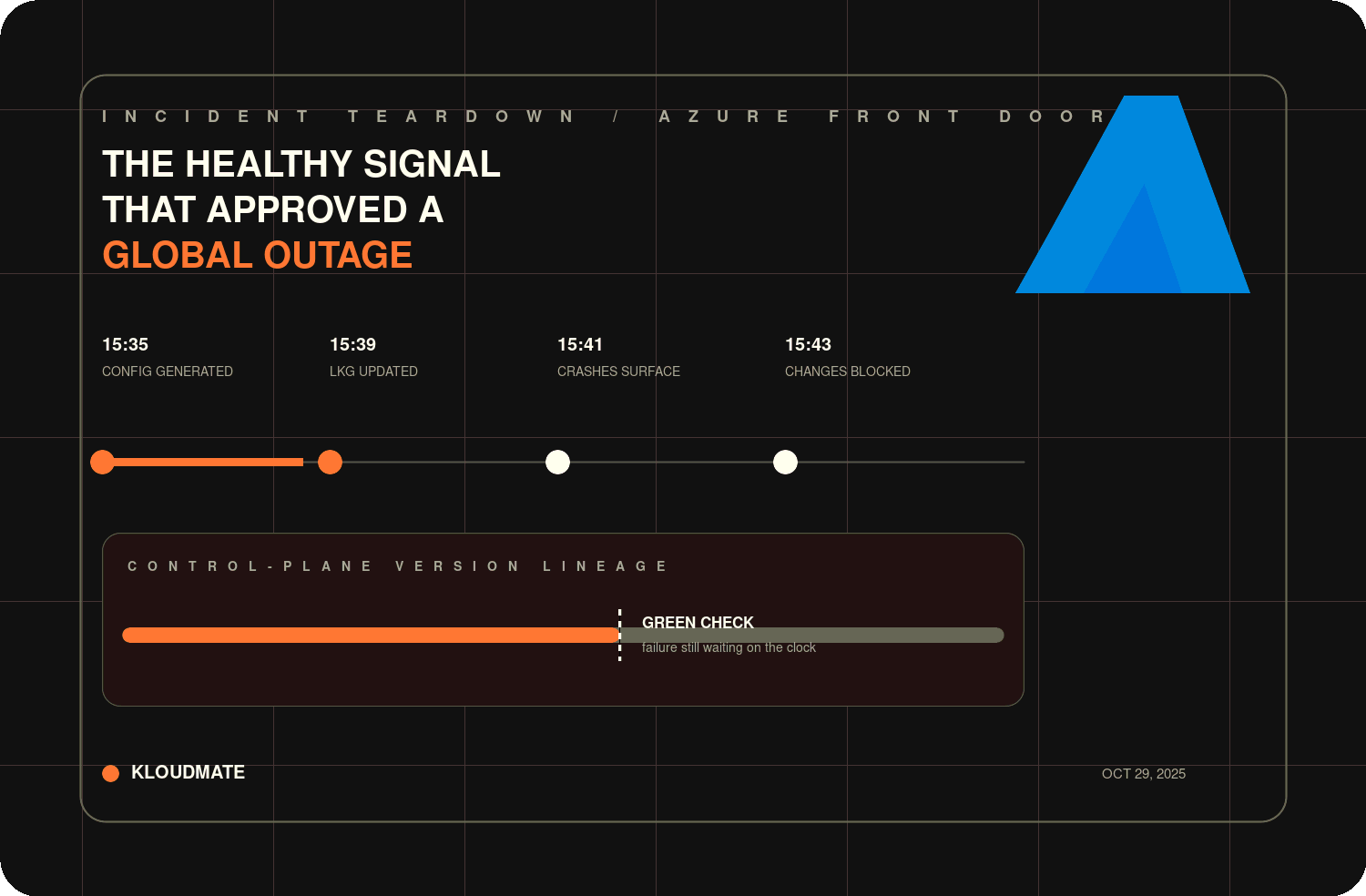
Front Door's control plane turns customer actions into metadata. Its globally distributed edge sites consume that metadata to serve requests. Because customers expect the same behavior worldwide, propagation is intentionally fast and global. In this case, the configuration reached pre-production at 15:36 and most edge sites by 15:39. The immediate health signals stayed green, so the staged protection system advanced the rollout and updated the last-known-good, or LKG, snapshot with the same configuration. (Microsoft PIR)
The dangerous sequence was already complete before customers saw an error:
Valid customer changes → incompatible metadata → green rollout checks → LKG updated
The failure was still waiting on a clock.
15:41 UTC: the delayed work starts crashing edge servers
About five minutes after configuration processing began, an asynchronous task encountered the latent defect. Edge processes crashed. Impact appeared in pre-production at 15:41 and had replicated across all edge sites by 15:45. Front Door's internal DNS service ran on those same sites, so a subset of requests also encountered intermittent DNS failures. (Microsoft PIR)
The full chain now looked like this:
Valid customer changes → incompatible metadata → green rollout checks → LKG updated → delayed data-plane crash → global connection and DNS failures
This was a temporal validation failure. The gates asked whether the fleet was healthy at each checkpoint. The defect needed several minutes to surface, after the checks had closed and after the recovery snapshot had been promoted.
The result was an outage lasting from 15:41 UTC on October 29 until 00:05 UTC on October 30: eight hours and 24 minutes. Azure Front Door and Azure CDN timed out connections and intermittently failed DNS resolution across multiple regions. Microsoft services on the same edge platform were affected too. Reuters documented downstream disruption to Microsoft 365 as well as airlines, airports and other industries. (Microsoft PIR, Reuters)
15:43 UTC: protection activates after the unsafe state is global
Azure Front Door's configuration-protection system reacted before the main monitoring alert. At 15:43, as data-plane problems spread, it automatically stopped new and in-flight customer changes. Microsoft says monitoring triggered the investigation at 15:48, seven minutes after customer impact began. By then, the incompatible metadata had reached most edge sites and the latest LKG contained it. (Microsoft PIR)
That timing changes how the safeguards should be judged. The system used multiple rollout stages, waited roughly a minute between them and advanced only after receiving positive data-plane health signals. Global propagation normally completed in five to ten minutes. The controls were real and functioning. Their observation windows were simply shorter than the defect's time to failure. (Microsoft PIR)
A canary is not safe because it exists. It is safe only when its observation window covers the ways a change can fail. Parsing, cache refresh, background compilation or asynchronous cleanup can all happen after an initial health gate closes. If those paths are not included in the bake period, a rollout can be healthy at every checkpoint and still carry a delayed fleet-wide failure.
The same timing flaw removed the obvious rollback. LKG was updated after the rollout received positive signals but before the crash appeared. The artifact intended to provide a clean recovery point captured the bad state. A recovery snapshot therefore needs an independent promotion rule, or at least a longer proof period, than the rollout it is meant to rescue.
17:10 UTC: recovery starts by repairing the fallback
Microsoft chose not to roll back to the latest LKG because it contained the conflicting metadata. Engineers also did not use an older snapshot because they could not do so with enough confidence. Instead, they edited the latest LKG to remove the problematic configurations. That work began at 17:10. Customer configuration propagation was blocked at 17:30, the corrected LKG began deploying at 17:40, and it was available to all edge sites by 17:50. (Microsoft PIR)
Recovery was not a switch. Every edge site had to reload customer configuration, then traffic had to return gradually so newly recovered capacity was not overloaded. Availability began improving around 18:30, often with elevated latency, and returned to its pre-incident state at 00:05. (Microsoft PIR)
The sequence, compressed:
| UTC | What changed |
|---|---|
| 15:35 | Incompatible metadata is generated. |
| 15:39 | The configuration reaches most edge sites; LKG is updated. |
| 15:41 | Customer impact begins as delayed crashes surface. |
| 15:43 | The protection system blocks new and in-flight changes. |
| 15:48 | Monitoring alerts trigger the investigation. |
| 17:10 | Engineers begin removing the problematic configuration from LKG. |
| 17:40 | Corrected LKG deployment begins. |
| 18:30 | Availability starts improving as traffic is rebalanced. |
| 00:05 | Availability and latency return to pre-incident levels. |
Read the outage from the request path, not the status page
The useful operational question was not "Is Azure down?" It was "At which layer are requests failing, and is the failure regional, network-wide or node-specific?"
Cisco ThousandEyes observed a globally scattered pattern rather than clean regional loss. Some connection attempts were reset or cancelled in roughly 10 milliseconds. Others timed out or returned HTTP 503 responses. Neighboring Front Door points of presence could behave differently, while reachability to Microsoft's edge network remained available. That combination pointed away from a systematic Internet routing or peering failure and toward failure inside the edge service. (ThousandEyes analysis)
A useful monitoring design would preserve that evidence instead of collapsing it into one availability number:
- Keep outside-in probes in several networks and regions. Record the responding edge, resolver path, failure mode and timing.
- Measure DNS, connection, TLS and HTTP separately. Intermittent DNS errors, fast resets, timeouts and HTTP 503s point to different stages of the request path.
- Compare the public edge with a private origin check. If the origin remains healthy while public traffic fails before reaching it, the application is not the first place to investigate. The origin probe should remain authenticated and private.
- Join change telemetry to delayed health. Track the configuration version loaded by each canary and edge cohort. Hold health gates open through asynchronous work, and alert when rollout version, crash rate and node restarts correlate even if the first minute is green.
The control plane needs its own lineage. For every propagated version, responders should be able to identify which build generated it, which schema produced it, which cohorts accepted it, whether background work completed, and whether that version was promoted to the recovery snapshot. Without those links, a global edge outage becomes a search across symptoms instead of a bounded change investigation.
The management path belongs in the same test. The Azure Portal was itself behind the affected route. ThousandEyes reports that Microsoft failed it away from Front Door at 17:26 to restore management access. Monitoring and recovery plans should answer a basic bootstrap question in advance: can responders still see, communicate about and control the system when the primary cloud console or edge provider is unavailable? (ThousandEyes analysis)
Decide the degraded path before the edge fails
A second delivery path can reduce dependency on one global edge, but it is not a checkbox. It needs independent DNS or traffic steering, certificates, security controls, origin capacity and a tested activation path that does not rely on the failing provider. Microsoft's guidance after the separate October 9 Front Door incident explicitly suggested considering Azure Traffic Manager to fail over from Front Door to origins. (Microsoft October 9 PIR)
For many teams, a fully independent edge costs more than the risk it removes. A narrower degraded mode may be more practical: keep critical APIs or a static status surface reachable through a simpler path, document which security controls disappear when bypassing the edge, and define the threshold for activation. Waiting can be a valid choice. Improvising during the outage should not be the plan.
The fixes follow the clock
Microsoft's repairs target both the incompatible metadata and the delayed execution path: fix the control-plane and data-plane defects, remove the asynchronous processing path, add a pre-canary stage, extend bake times, and reduce estimated data-plane recovery from about 4.5 hours to about one hour. Microsoft temporarily blocked Front Door customer configuration changes at the Azure Resource Manager level, began draining the queue on November 2, and removed the restriction on November 5 after safeguards were in place. (Microsoft PIR, Microsoft follow-up)
This was the second Azure Front Door configuration-propagation incident in October 2025, but Microsoft says the defects were different. On October 9, the protection system initially caught erroneous metadata; engineers later bypassed that protection during cleanup, allowing the bad metadata to propagate. On October 29, incompatible metadata passed the safeguards because its crash was delayed. (Microsoft October 9 PIR, Microsoft October 29 PIR)
The common constraint is time. Global edge platforms must propagate configuration quickly, but propagation cannot outrun the time needed to prove safety. Validation must cover mixed control-plane versions. Canary bake periods must include asynchronous work. LKG promotion must be harder than rollout promotion. Recovery capacity must be observable before traffic returns to it.
The strongest incident signal was not total availability. It was the relationship between a configuration version, where it had propagated, and what happened several minutes later. Monitoring that relationship turns a worldwide outage from a mystery into a failed change with a bounded blast radius.
Sources
- Microsoft Azure: Post Incident Review - Azure Front Door connectivity issues, October 29, 2025 (Tracking ID YKYN-BWZ)
- Cisco ThousandEyes: Microsoft Azure Front Door Outage Analysis, October 29, 2025
- Reuters: Microsoft Azure's services restored after global outage
- Microsoft Azure: October 9, 2025 Azure Front Door PIR (Tracking ID QNBQ-5W8)
- Microsoft: Azure Front Door - Implementing lessons learned following October outages